

In any proper democracy, public officials are held to far more than vague notions of ‘good character.’ They are expected to account for their actions, clarify allegations, and be transparent. So when Sen. Joel Villanueva claims that Wawao Builders GM Mark Allan Arevalo still has ‘good character’ because he refused to speak during interpellation on account he allegedly knows about ghost flood control projects—it invites more questions than it answers. And when Undersecretary Claire Castro challenges that argument, she is right to do so: silence is not proof of integrity.
To remark that someone’s refusal to speak amid interpellation demonstrates ‘good character’ is deeply problematic. In legal and political settings, silence can result from many motivations: fear, legal counsel, indecision, or even tactical delay. None of these necessarily signal moral uprightness. On the contrary, refusing to respond can also be an attempt to dodge accountability.
Public officials, especially those involved in infrastructure projects where public monies and public welfare are at stake, must be judged by their actions, transparency, and willingness to face scrutiny, not by whether they chose to respond at a particular moment. The measure of ‘good character’ in public service should be tied to responsibility, not reticence.
It is also disingenuous to treat Arevalo’s silence as a sign of nobility when Sen. Villanueva himself has already been implicated in the very same controversy. According to the testimony covered by AP News, a former Department of Public Works and Highways (DPWH) engineer testified under oath that Villanueva was included in alleged flood control kickbacks in Bulacan. Although denied by Villanueva, this is not idle gossip; it is part of an ongoing congressional inquiry, one that has put flood control spending under a harsh spotlight. For Villanueva to invoke ‘character’ while his own name surfaces in corruption allegations is, at best, tone-deaf.
What makes this even more pressing is the nature of the projects under scrutiny. Flood control infrastructure is a matter of public safety in a country battered yearly by typhoons. The Commission on Audit (COA) has already ordered fraud audits and physical inspections to verify whether these projects truly exist or are ‘ghost’ undertakings. Billions in taxpayer money are at stake. In such a context, silence is not a badge of honor. It is a red flag.
This is why Presidential Communications Office Undersecretary Claire Castro’s challenge to Villanueva was necessary. By asking whether silence during an interpellation truly reflects good character, she struck at the heart of the issue. Accountability depends on transparency. If we start equating silence with virtue, we lower standards for public officials and contractors, effectively allowing them to hide behind evasiveness. Castro’s example of former DPWH Secretary Mark Villar further underscores the point: whether someone speaks or not is irrelevant. What matters is what they actually do with the authority and responsibility entrusted to them.
The burden of proof lies with those accused. While the legal system presumes innocence until proven guilty, the moral obligation of public officials is to uphold public trust. That means cooperating fully with investigations, presenting documents, and answering interpellations– not hiding behind silence or vague appeals to character. For Sen. Villanueva, who himself has been linked to questionable projects, the call to transparency is even louder.
If good character is to mean anything in public life, it must be tied to accountability, openness, and truth. Claiming that someone’s silence is evidence of goodness undermines these values and weakens public faith in governance. The public is asking for answers. And right now, both Arevalo and Villanueva owe the people far more than silence.
Opinion
Quiet, But Not Innocent
In any proper democracy, public officials are held to far more than vague notions of ‘good character.’ They are expected to account for their actions, clarify allegations, and be transparent. So when Sen. Joel…
· 3 min read

–views
18.4
How did this story make you feel?
Be the first to react · no sign-in needed
More from Opinion
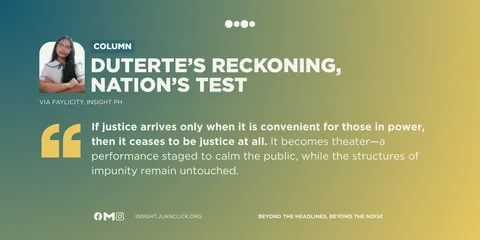
Duterte's Reckoning, Nation's Test
Lia Abellana (Faylicity) · Sep 19, 2025 · 2 min
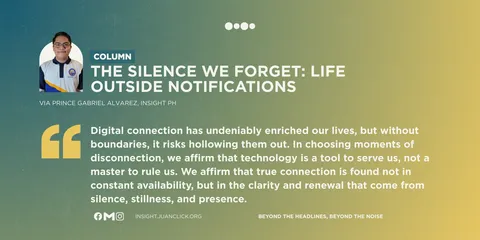
The Silence We Forget: Life Outside Notifications
Prince Gabriel Alvarez · Sep 21, 2025 · 3 min
Email news
Get the stories that matter, straight to your inbox.
Breaking news, a daily digest at 7:00 AM, or a Sunday round-up. English, Filipino, or both. Unsubscribe anytime.
Comments
Be civil. Read the Comment Guidelines.
Loading comments…