

Rodrigo Duterte’s arrest under the International Criminal Court has torn open a national divide. For victims’ families and human rights advocates, it is a long-delayed recognition that the drug war’s casualties were not just statistics but lives stolen without justice. For his defenders, it is nothing less than an insult to Philippine sovereignty—a foreign court daring to put on trial a leader many still call their champion.
Instability has now seeped into the economy. Investors may not be fixated on Duterte himself, but they are wary of what his case represents: a divided, distracted nation. Street protests, heated debates in Congress, and a visibly fractured public signal fragility. Markets do not fear justice, but they do recoil at turbulence. And in an election year, the Philippines can hardly afford to appear brittle.
It’s tempting to view this moment as closure, as though accountability has been achieved simply because a warrant was served. That illusion is dangerous. Justice is not secured by one high-profile arrest; it is built on institutions strong enough to hold leaders accountable regardless of power or popularity. Without those foundations, the cycle of impunity simply waits for its next figurehead.
Meanwhile, everyday struggles grind on. Inflation eats into paychecks, classrooms and hospitals strain under tight budgets, and communities devastated by floods and storms await long-promised relief. For many Filipinos, the ICC’s ruling is distant news compared to the price of rice or the cost of a jeepney ride. A nation transfixed by spectacle risks neglecting its present.
This is what makes Duterte’s case both historic and dangerous. If reduced to partisan theater, it will only deepen public cynicism toward politics and law. But if seized as a turning point, it can mark the beginning of reforms that outlast one man’s fall. Stronger oversight, courts free from political pressure, protection for whistleblowers—these are the real markers of accountability. They are also the reforms that require political courage, because they cut deepest at those in power.
Duterte’s arrest is not just his reckoning. It is ours. The Philippines must now decide whether justice will remain a performance or finally become a principle. That choice will define not only Duterte’s legacy but our own capacity to learn from history instead of repeating it.
Opinion
Duterte's Reckoning, Nation's Test
Rodrigo Duterte’s arrest under the International Criminal Court has torn open a national divide. For victims’ families and human rights advocates, it is a long-delayed recognition that the drug war’s casualties were not…
· 2 min read

–views
18.4
How did this story make you feel?
Be the first to react · no sign-in needed
More from Opinion
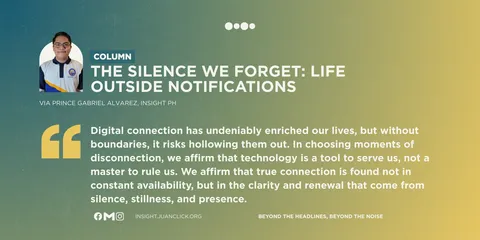
The Silence We Forget: Life Outside Notifications
Prince Gabriel Alvarez · Sep 21, 2025 · 3 min


Diluted Creativity - The Only Truth That Lies
Antonino Illias V. Leonardo · Sep 21, 2025 · 2 min
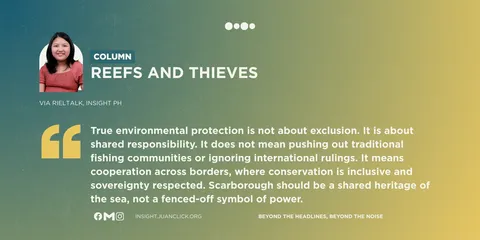
Reefs and Thieves
Akia Zuriel De Guzman Besin (RielTalk) · Sep 21, 2025 · 2 min
Email news
Get the stories that matter, straight to your inbox.
Breaking news, a daily digest at 7:00 AM, or a Sunday round-up. English, Filipino, or both. Unsubscribe anytime.
Comments
Be civil. Read the Comment Guidelines.
Loading comments…