

Somewhere between a power line and a prayer. The Philippines, it seems, is ready to let the machine dream. President Ferdinand Marcos Jr. has declared that the government will use artificial intelligence “as much as we can, as soon as we can,” calling it both an inevitability and an opportunity the nation can’t afford to ignore.
It’s a statement that feels like a spark bright, promising, and just a little bit dangerous.
AI isn’t just code anymore; it’s the quiet revolution humming beneath bureaucracy. Marcos says the country must “learn fast” and consult experts before diving in but dive in, it will. The goal is to build a government that runs not on pens and paperwork, but on data, prediction, and machine precision.
Imagine disaster systems that can warn before the flood. Imagine documents that fill themselves. Imagine decisions guided by patterns no human could see. This can all be achieved with the right governance, right funding, and right minds. But even then, the people should tread lightly, for AI shouldn't be something to replace what we already have, it should be a helping hand.
The President calls it modernization. The scientists call it transformation. The rest of the masses could call it a gamble
For AI to truly serve, it must learn that the Philippines is a nation of islands, contrasts, and contradictions. Clean data is rare. Internet access is uneven. Many local offices still run on typewriters and trust. That’s the challenge. How to teach a machine empathy. How to make it understand why one barangay floods while another prays for rain.
Experts warn that AI can only be as fair as the people who feed it. If the code learns from flawed systems, it might automate bias instead of erasing it. If left unchecked, it could process people like numbers fast, efficient, and heartless. Still, Marcos insists: “We must do it. And we must do it right.”
There’s something poetic in the urgency the image of a government trying to digitize its soul. The President imagines a future where machines make governance faster, cleaner, more transparent. But what happens when the system starts to think for itself?
AI isn’t a monster waiting to take over. It’s a mirror. And in that reflection, we’ll see our data, our biases, our intentions. Magnified in silicon and light. So maybe that’s what this moment really is not a revolution, but a rehearsal. The machine is learning our language, and we are learning its logic. Somewhere between those frequencies, a new kind of governance might be born.
When the circuit dreams, may it dream in our image, not perfect, but human.
May it serve, not rule.
And every testament between powerlines, every prayer written in code, shall lead into a nation learning to think and feel, in code.
SciTech
When the Circuit Dreams: The Philippines’ Race Toward AI
Somewhere between a power line and a prayer. The Philippines, it seems, is ready to let the machine dream. President Ferdinand Marcos Jr. has declared that the government will use artificial intelligence “as much as we…
· 2 min read

–views
18.4
How did this story make you feel?
Be the first to react · no sign-in needed
More from SciTech
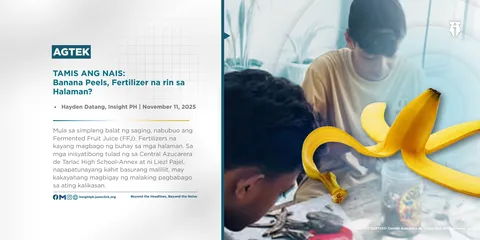
Filipino
TAMIS ANG NAIS: Banana Peels, Fertilizer na rin sa Halaman?
Hayden Datang · Nov 10, 2025 · 3 min
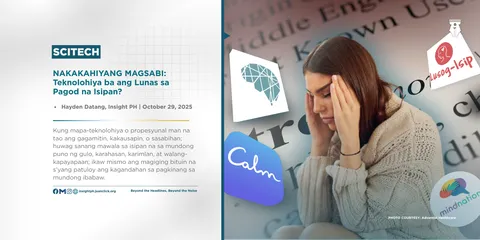
Filipino
NAKAKAHIYANG MAGSABI: Teknolohiya ba ang Lunas sa Pagod na Isipan?
Hayden Datang · Oct 29, 2025 · 4 min

AN INVASIVE SOLUTION: How can invasive plants be herbicidal?
Mark Jerence S. Domingo · Nov 26, 2025 · 3 min
Email news
Get the stories that matter, straight to your inbox.
Breaking news, a daily digest at 7:00 AM, or a Sunday round-up. English, Filipino, or both. Unsubscribe anytime.
Comments
Be civil. Read the Comment Guidelines.
Loading comments…